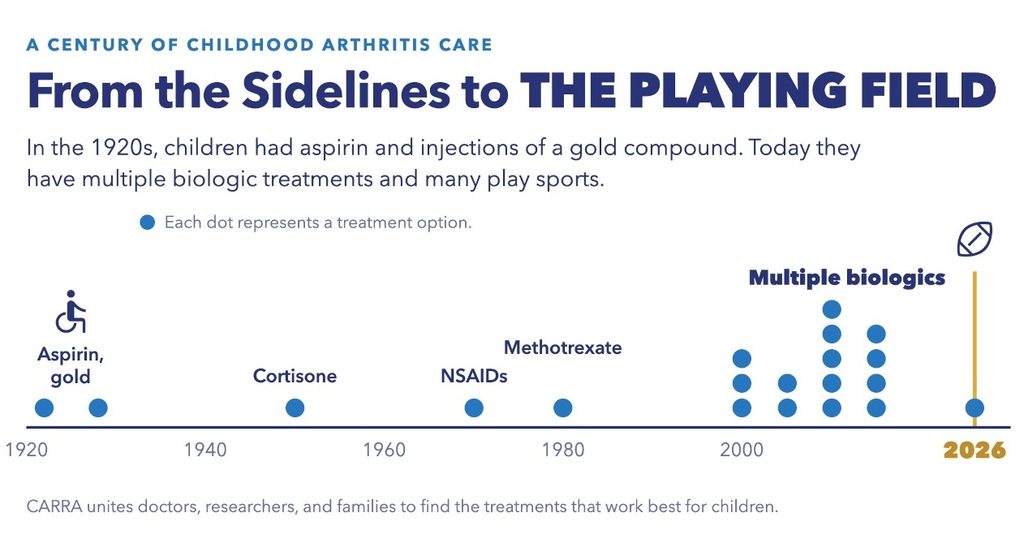
Many pediatric rheumatologists remember a time – not very long ago – when their clinics were frequented by kids using wheelchairs or assistive devices. Today, most of their patients with juvenile idiopathic arthritis (JIA) are active and many are participating in sports.
The introduction of biologics in 1999 transformed the options and significantly reduced joint damage and disability in kids with JIA, wrote CARRA leaders in a JIA review article in The New England Journal of Medicine.
Harry Saal, a longtime CARRA board member, described the treatment landscape for his daughter, Jessica, who passed away from complications of JIA. When Jessica was diagnosed in 1972, the only available treatments for JIA were aspirin and injections of a gold compound, Saal explained.
“Neither seemed to help,” Saal said. “Back then, virtually all of the kids with arthritis had deformities and many needed wheelchairs.”
What Changed for Kids with Juvenile Idiopathic Arthritis?
Today, it’s dramatically different. Doctors rarely see kids with abnormal joints caused by JIA – so rarely in fact, it’s sometimes challenging to teach trainees how to do a joint exam, said Dr. Polly Ferguson, MD, vice chair of the Department of Pediatrics and Director of the division of Rheumatology, Allergy, and Immunology at University of Iowa Stead Family Department of Pediatrics.
“These treatments have transformed pediatric rheumatology, and children have gone from struggling with pain and limping around to fully participating in sports and activities,” said Dr. Ferguson. “I have had a patient who was an elite ballerina and another who was nationally ranked swimmer.”
When biologics arrived, pediatric rheumatologists wanted to study them and monitor their long-term safety in children.
Why can’t one hospital study JIA alone?
Although JIA is the most common chronic rheumatic disease in children, it is still rare enough that a single medical center typically doesn’t see enough patients to generate robust data for research. By bringing patients together across centers, physicians can conduct meaningful research.
The CARRA Registry made this possible. It is the largest observational registry in North America, collecting clinical and patient-reported information about children and young adults with pediatric-onset rheumatic diseases. It also serves as a biosample repository for select translational studies.
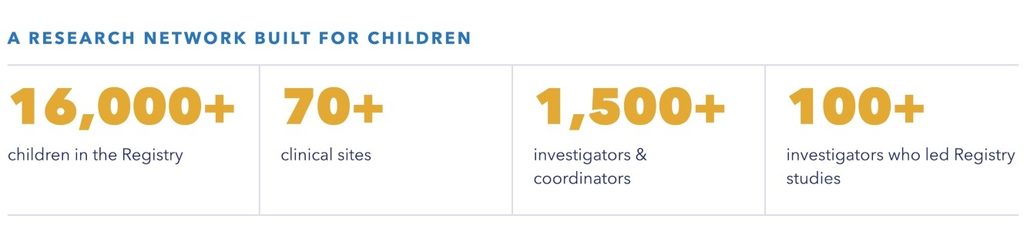
- Since 2015, the Registry has enabled studies that have led to more than 40 publications about JIA.
- The CARRA-Arthritis Foundation Grant Program, since its inception in 2016, has provided nearly $12 million to support physician-led research in JIA and other pediatric rheumatic diseases.
How did research lead to new approved medicines?
CARRA builds evidence to support approvals. Here’s one example of how that unfolded:
- In 2018, CARRA brought together multiple stakeholders invested in JIA treatment development:
- The Arthritis Foundation
- Regulatory agencies, such as the (U.S. Food and Drug Administration and the European Medicines Agency)
- Major pharmaceutical companies
- Pediatric rheumatology clinicians and investigators.
- They addressed a growing challenge in JIA clinical trials; fewer patients were eligible and willing to participate in clinical trials, while the number of medications being tested was growing. Later that same year, the Arthritis Foundation and CARRA convened the JIA community for a Patient-Focused Drug Development meeting to help inform regulatory decisions.
- In October 2019, the FDA hosted a workshop on accelerating drug development for polyarticular JIA (poly JIA), a type of JIA that affects five or more joints. Registry data showed the unmet need:
- 45 percent of participants had chronically uncontrolled disease despite trying two or more biologics.
- At least 15 percent had been prescribed a biologic not approved for their disease.

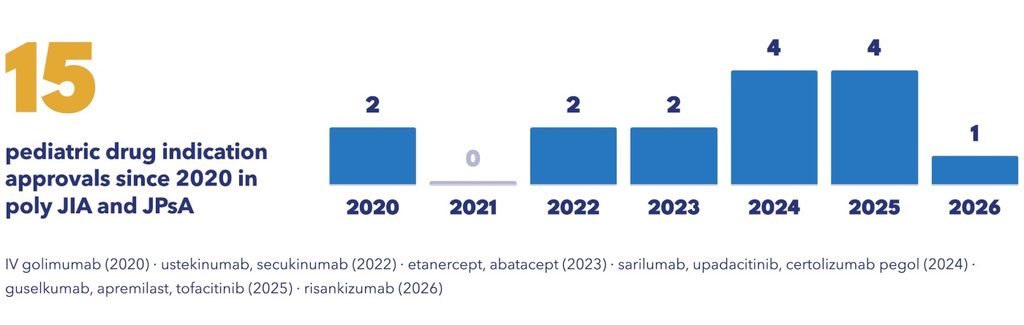
This work helped give the FDA a scientific foundation to support efficacy extrapolation using adult data in children, opening the door to a wave of new, formally approved therapies. The result: 15 pediatric drug indication approvals since 2020 in poly JIA and juvenile psoriatic arthritis (JPsA).
Why approval matters to families:
- Easier access to treatments
- More likely to be covered by insurance
- More closely monitored for long-term safety than off-label options
“Everything has changed incredibly, and CARRA has played an important role in that and in working with pharma to monitor to make sure these treatments are safe and effective,” Saal said.
Finding the Best Treatment Option
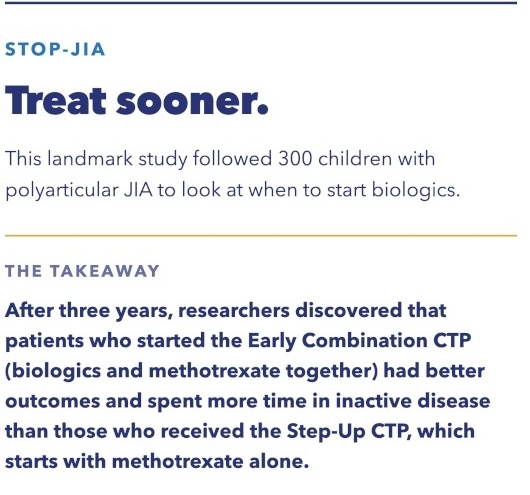
A landmark study using the CARRA Registry looked at when to start biologics in children diagnosed with poly JIA, and found that early use of biologics improves outcomes.
After following nearly 300 children with poly JIA for three years, researchers discovered that patients who started the Early Combination Consensus Treatment Plan (CTP) (biologics and methotrexate together) had better outcomes and spent more time in inactive disease than those who received the Step-Up CTP, which starts with methotrexate alone and adds a biologic later if needed. Patients who start biologics very early (by two months) had the best disease trajectory.
The study is known as STOP-JIA (Start Time Optimization of biologics in Polyarticular Juvenile Idiopathic Arthritis consensus treatment plans study). CTPs are a specific set of treatment options that were developed based on literature review and agreement among family and health care providers of children with rheumatic diseases.
STOP‐JIA, which was the first study to use this novel approach to comparative effectiveness research, received funding from the Patient-Centered Outcomes Research Institute (PCORI).
What happens when the biologic doesn’t work?
Another groundbreaking study is SMART-JIA (Sequential Medications after TNFi failure in JIA) the first international collaboration between CARRA, the Pediatric Rheumatology European Society, and the Pediatric Rheumatology International Trials Organization.
It compares a common biologic to three alternatives to develop a treatment protocol for children with poly JIA who didn’t respond to their first medication. About 25% of children with poly JIA do not respond to initial treatment.
STOP-JIA and SMART-JIA, which are answering important questions that both families and physicians have, are the kind of research that is only possible through a network like CARRA.
The work isn’t finished
Still, many challenges remain.
- Some children and teens still don’t have a medication that works for them, as they continue to endure pain and limitations in their daily lives.
- Many kids also face side effects and may have weakened immune systems as a result of using medications like biologics and steroids.
Shaw McGrath, a teen living with poly JIA and enthesitis-related arthritis, described his treatment as a process of trial and error.
“Some treatments helped more than others, but none offered a simple or immediate solution,” he wrote in a recent blog. “I had to learn that managing juvenile arthritis is not always about finding one perfect answer. It is about continuing to ask questions, paying attention to your body, and adjusting when something is not working.”
“We still don’t have a cure, and children still face complex medical problems, limited access to care, and social challenges,” Saal said. “Our work is not done.”
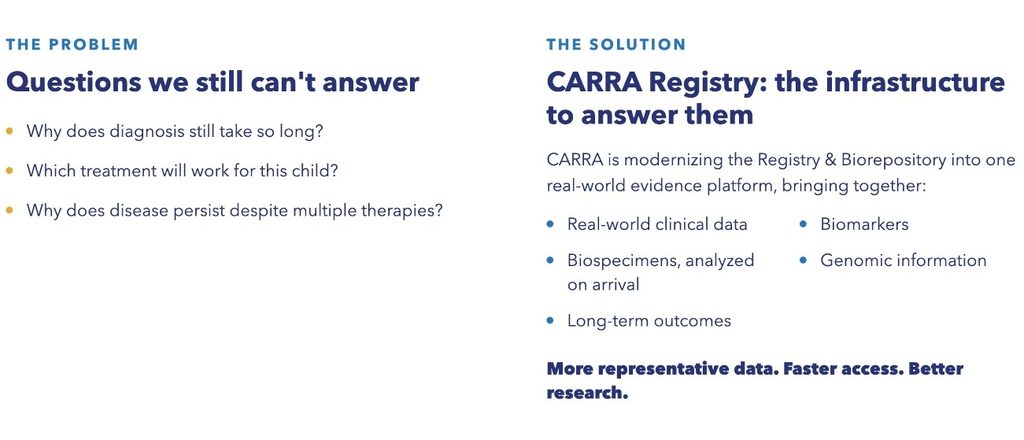
Help answer the questions no single hospital can answer alone
Your support helps CARRA turn the experiences of thousands of children into evidence that can improve care for the next child. The goal isn’t more data. It’s better answers for the next child.