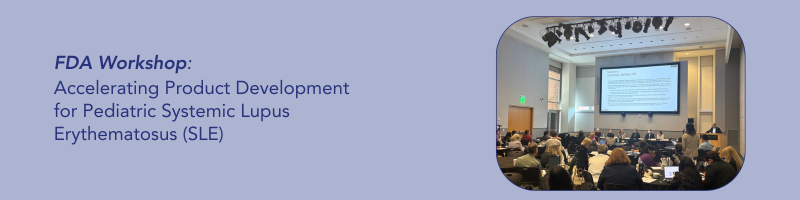
Physicians, researchers, regulators, pharmaceutical industry leaders, and patient advocates came together recently at the U.S. Food & Drug Administration (FDA) to work towards getting treatments approved more quickly for pediatric lupus.
CARRA and the Pediatric Rheumatology Collaborative Study Group (PRCSG) collaborated to plan the FDA Workshop: Accelerating Product Development for Pediatric Systemic Lupus Erythematosus (SLE). This important event provided a unique opportunity for a broad group of stakeholders to discuss ways to streamline drug development, while ensuring that the pediatric rheumatology community’s voices are included in regulatory decision-making.
Children and teens living with SLE face substantial unmet need because:
- Severe disease impact – SLE can seriously affect quality of life, growth, and even long‑term survival.
- Only one approved medication – Children currently have access to just one FDA‑approved treatment.
- Significant treatment gaps – Physicians and patients consistently report limited effective options for pediatric SLE.
- Delayed pediatric approvals – The only approved medication took eight years to move from adult approval to pediatric approval.
Now, attendees will come together to dive deep into the challenges and opportunities that are faced by these patients and make collaborative recommendations for crucial next steps in getting treatments to children faster.
In the meantime, CARRA is excited to share some highlights from the workshop.
The Burden of Pediatric SLE
SLE is a chronic, multisystem autoimmune disease characterized by inflammation, autoantibody production, and alternating periods of disease flares and remission. As many as 20% of cases begin during childhood.
Although lupus generally affects children and adults in similar ways, children are often at higher risk for:
- More severe and aggressive disease
- Damage to organs (heart, lungs, brain, kidneys and skin)
- Harmful effects from long-term use of corticosteroids (i.e. children start medicines at an earlier age than patients diagnosed as adults)
“A lot of young people are forced to go the steroid route because they simply don’t have other options,” said patient panelist Chloe Raymond, noting that many of the treatment options did not work for her. “We know so much that is bad about steroids, so finding more treatment options for young kids is so important.”
Long-term use of corticosteroids in children can stunt growth, weaken bones, cause metabolic problems, disrupt moods, and even damage eyes.
Living with pediatric lupus affects the entire family, contributing to mental health challenges, parents’ missing work for medical appointments, and additional school absences due to more frequent illnesses caused by immunosuppressive treatments.
“I have seen my husband have to carry my daughter because she couldn’t walk and I have seen it cause her grades to slide at school,” said panelist Elizabeth SantaCruz. “Lupus affects a child in so many ways.”
Better Access to Treatments
Physicians emphasized how the lack of treatment options affects patients.
“We need therapies now and each day that there is a delay in an effective therapy is palpable when we walk into a patient’s room,” said Stephen Balevic, MD, PhD, who is board-certified in both adult and pediatric rheumatology and takes cares of patients at Duke Health.
They also underscored the importance of access to approved treatments, with one physician noting that delays in insurance approvals – even for commonly prescribed medications such as MMF – are increasing from a couple of weeks to as long as a couple of months.
“We have to look at the whole picture and that includes how patients can actually get access to the medication,” said patient speaker Mckenna Bowes, who described recent challenges in accessing her medication.
Challenges of clinical trials in pediatric SLE
The workshop explored the reasons why there is a lack of approved treatment options for pediatric SLE. Conducting clinical trials in pediatric SLE presents several challenges:
- a small patient population
- limited specialized centers
- difficulties with recruitment and retention
Hermine Brunner, MD, MSc, MBA, who is the scientific director of PRCSG, described how in a recent clinical trial, 26 percent of eligible patients declined to participate because they could not commit to the visits required in the trial.

“If you’re on an hourly wage, then every hour spent at the hospital is lost income,” said Brunner, highlighting the importance of reimbursements for time and travel for families.
Given the challenges in conducting pediatric SLE clinical trials, clinical trial design was a key focus of the agenda. The workshop evaluated how existing data from adult SLE studies may be extrapolated to pediatric populations to streamline drug development to more efficiently bring to market safe and effective therapies to children. This approach could also reduce the burden of clinical research in children living with SLE.
Researchers discussed how pharmacokinetic (PK) and pharmacodynamic (PD) studies may be used to extrapolate data from adult studies to prove that a drug affects children in the same way it affects adults.
“As a clinician, open-label PK/PD safety study seems to be really walking the line of optimal risk benefit,” Balevic said. “Time is damage and damage is life. We can’t compromise science and we have to make sure that we have the right data to make an informed regulatory decision, but there is this need to balance that with not requiring extraneous data because that time and that complexity does add cost to our patients.”
Balevic, who earned a PhD in Pharmaceutical Sciences, has research expertise in clinical trials and precision medicine through population PK/PD modeling.
Industry insights into pediatric SLE studies
The workshop included key insights from industry leaders: a session on safety assessment and extrapolation in pediatric SLE and a presentation on trial design considerations.
Martine Dehlinger-Kremer, PhD, MS, the senior development strategy lead for pediatrics and special patient populations at UCB Biosciences, explored the opportunities and key considerations in the full extrapolation of efficacy from adults supported by an open-label PK matching or PK/PD study. Families find this trial design highly acceptable due to the absence of a placebo/standard treatment control, she said. Additionally, this design minimizes pediatric sample size and is operationally feasible, while enabling accelerated pediatric development and earlier access to treatments.
However, Dehlinger-Kremer noted that an open-label PK matching or PK/PD study requires strong justification that disease biology and treatment response are sufficiently similar between adults and pediatric patients, and PK comparability (and PD comparability, if included) must be demonstrated. Further, she noted that residual uncertainty may remain regarding pediatric efficacy. Potential differences in disease phenotype and baseline characteristics (e.g. higher prevalence of lupus nephritis and greater disease activity in pediatric SLE) may affect extrapolation.
Laurie Conklin, MD, director of the child health innovation and leadership department at Johnson & Johnson, gave a presentation on safety assessment and extrapolation in pediatric SLE. She cited the risk that an adult phase 2 trial may not succeed, and early pediatric investment can be stranded if the adult program fails. Conklin also highlighted the opportunities that extrapolation provides to avoid generating unnecessary data and to answer the questions that need to be answered working toward a common goal to bring medicines to children with SLE.
“From an industry perspective, we do want to get medicines to patients as soon as possible,” said Laurie Conklin, MD, of Johnson & Johnson.
Dehlinger-Kremer’s presentation also gave an overview of key considerations when including adolescents in adult trials – from endpoint suitability and safety to site logistics and how regulatory feedback could impact the adult Phase 3 design.
Regulatory perspectives
The workshop included leaders from both FDA and the European Medicines Agency (EMA) to provide the regulatory perspective and discuss ways to move towards harmonization between the two agencies.
It also included pharmacology experts who weighed in on the similarities and differences between adults and pediatric SLE in drug pharmacology and statistical approaches to optimizing dose selection. Age was another key point in the discussions, with researchers noting the scientific and ethical considerations, as well as discrepancies across different countries.
Age is a very poor biomarker, noted Lynne Yao, MD, the director of division of pediatric and maternal health at the FDA’s Center for Drug Evaluation and Research.
“It’s a regulatory and legal definition, but it’s not really a good biomarker,” Yao said. “What we would like to see, and I think what you’re saying, is just give us the justification scientifically or clinically that this is the population that you need to enroll. Is it 9 to 25 or is it 5 to 25 – what is that population?”
There was general agreement that SLE is similar across adults and children five years and over, which may have important regulatory implications for use of extrapolation and inclusion in trials.
What’s next?
Stakeholders agreed these two days of collaboration were highly valuable and productive. The workshop, which was co-hosted by the FDA and the Center of Excellence in Regulatory Science and Innovation, was held at the FDA in Silver Spring, Maryland on July 30-31, 2026.

“Participating in the FDA workshop was a meaningful experience with real discussion amongst the stakeholders,” said Mary Beth Son, MD, Clinical Chief of the Division of Immunology at Boston Children’s Hospital. “I am optimistic that change will occur and FDA approved medications for children and adolescents with SLE are on the horizon.”
Son noted that patients and families made an invaluable contribution to the conversations. CARRA collaborated with the Lupus and Allied Diseases Association, Inc. (LADA) to engage and empower patients and families living with lupus to participate in the FDA workshop. Special thanks to Kathleen A. Arntsen, president and CEO of LADA, and Anne M. Zablotowicz, a vice president at LADA.
“This event was remarkable in that showcased that physicians, physician scientists, patients, industry partners, and regulatory colleagues are very committed to improving access to safe and effective treatments for children with lupus,” said Stacy Ardoin, MD, MSc, who is board-certified in adult and pediatric rheumatology and is the past president of CARRA.
FDA and EMA officials noted plans to continue discussions and work toward developing a framework for SLE programs. During the workshop, participants expressed their desire for a single pediatric program that would satisfy both FDA and EMA to accelerate treatment development. Meanwhile, meeting participants are working on publishing the proceedings of the FDA Workshop and recommendations for next steps, including highlighting the critical patient and family perspective that shaped the meeting.
CARRA and PRCSG are poised to support these efforts together.
The CARRA Registry, which is the largest ongoing, observational registry in North America, collects clinical and patient-reported information in pediatric rheumatic diseases, such as lupus. The CARRA Registry serves as an important real-world data source which can be used to inform study design, extrapolate efficacy data, and facilitate safety and efficacy monitoring once a drug is on the market and being prescribed.
PRCSG, which is a consortium of over 80 academic clinical pediatric rheumatology centers in the United States and Canada, has completed, or is currently in the process of conducting, more than 45 trials in children with rheumatic disease, including SLE. PRCSG has performed the vast majority of trials of medications for JIA in North America since 1977.